
About three years ago an idea was born. Whispers of it already existing, rolling around in our heads, but the framework was spoken into being officially. It began simple at first: what do we enjoy and if we could work on something that brings us joy what would that look like. This paragraph is not yet about the products but the idea that brought them together. And as we dreamed louder the engineering began. We love and I do mean LOVE botanicas and all things woo woo. Magic? Yes we are there. But more than that we needed to also weave in our values. And this was how Esotérika began. As we spoke it into existence our #MagicWithAMission became the cornerstone that everything else was anchored to. To have a one stop shop for all things magic, goth core to cottage core and to build everything from the central perspective of doing what capitalism has long promised the masses. That supposed trickle down, the bringing good to a community, the uplifting of humanity, etc. Which is a HUGE improvement from wanting to just burn capitalism to the ground, which speaking for myself on this one, was definitely the pipe dream of my youth. In my middle years, however, I am wise enough to understand that lasting change is slow moving. Rapid change fizzles out regardless of how much it is critically needed.
But for this post, I would like to hover on one of the first products we decided to make, specifically soaps and the proprietary blend of fragrances we carefully formulate to uplift, inspire and simply make the mundane come alive with magic.

Breaking Bad Science Shit
Let’s talk soap basics first. First and foremost soap is the result of a CHEMICAL REACTION of mixing fats and oils with a caustic alkali water in its caustic state and always has been. While for thousands of years, the language for understanding the molecular chemistry behind what created soap was not yet defined, the process was very much so still occurring. The only difference between then and now is precision. Soap thousands of years ago could be incredibly harsh on the skin simply because of the process it took to draw the “potash” out from wood ash made it nearly impossible to know how much was in any given batch. Whereas now, we stand on the shoulders of our ancestors and have at our disposal precision measuring equipment and tried and true ratios.
What has not changed over the course of millennias is the need to protect one’s skin and eyes when making soap. It is important to understand that sodium hydroxide (lye) and potassium hydroxide (potash) are in their caustic state prior to saponification (the chemical reaction that leads to soap). For the purposes of this post, I will explore the caustic soda (sodium hydroxide or lye) used more with more prevalence over the course of the past 250 years. The chemical structure for Lye (NaOH) is: sodium as its metallic base. Sodium molecules bind tightly with fat molecules, creating a crystalline structure that hardens into a solid bar as it cures. Potash, its ancestor (though still in use for certain products in some capacity) uses potassium as its metallic base. Potassium molecules hold onto water much more loosely than sodium does, which prevents the soap from ever fully hardening and therefore tends to lead to mushy or soft bars at best that dissolve quickly through the course of use.
If you are anything like me, you LOVE research, science and math. And if you are not, no worries, I will enjoy that for the both of us.
So question for the class. Just how caustic is lye? Industrial grade lye has been used as both a weapon and sanitizing agent in times of war, disease, and famine. Even prior to the advent of modern chemistry practices, calcium oxide (quicklime that functions the same when exposed to moisture as lye) was used to blind enemy combatants. Many modern military forces use lye in mortars to cause particular damage to enemies and civilian populations alike. However, it isn’t solely used as weapon by military forces. It is actually more commonly used as a defensive measure. Due to the same properties in lye that turn fat into soap by aggressively breaks down organic molecules, use a process called chemical hydrolysis, lye is used to destroy chemical weapons stockpiles. Throughout history lye has been used in mass burials (Civil War, WW2, famine & disease outbreaks) or even to dispose of infected animal carcasses or contaminated human medical tissue safely through a highly specialized machine called an alkaline hydrolysis chamber. By cranking up the heat and the pressure, the lye completely dissolves all flesh, blood, and pathogens into a sterile, liquid soap-like slurry, leaving behind nothing but brittle, clean bone fragments.
At this point, if you are like me you are looking at lye a little bit like lightning. Both terrify and awe-inspiring. Lye purchases are tracked due to its capability to become a weapon in the right conditions. Soap making isn’t exactly those conditions. In fact if you are imaging the cartel movies with a body smushed into a plastic barrel filled with lye and thinking the body is poof gone, well that is pure Hollywood. The reality is, without the presence of the right equipment and conditions, the best you could hope for is a no-bake instant mummy.
This doesn’t mean that lye and thereby the saponification process is not to be approached without caution or the utmost respect (like lightning). If you catch us on a soap making day just know we look like we have a mini Breaking Bad setup in our house. We even have the protective personal equipment to complete the designer look.
Aroma Therapy for the Soul (from a mathaholic)
Aroma Therapy for the Soul
(from a mathaholic)
While we do use essential oils exclusively in some products, soap is not one of them, simply because it is impossible for all of the benefits essential oils to survive the saponification process due to the temperatures occurring during that chemical process aside from moisturization and aroma in certain essential oils. For that reason we only call it aroma therapy for the soul. Not the actual medicinally/therapeutically based aromatherapy.
Scents stimulate the olfactory nerve, sending signals directly to the brain’s limbic system—the area that controls emotions, memory, and mood. From a purely biological standpoint, your nose cannot tell the difference between a natural scent molecule and a synthetic replica.
As it pertains to soap making, essential oils are not just cost-prohibitive but are volatile when exposed to heat. Depending on the specific essential oil used the medicinal/therapeutic benefits are either highly degraded or entirely lost. This has lead some to try stronger amounts of essential oils that can risk causing chemical burns to the skin.
For body products that involve heat we do defer to mild and minimal essential oils blended into fragrance oils. The former in precise measurements based on the heating levels to only leave the moisturizing benefits. And the latter to spark that magic only a specific scent can provide while remaining fully stable through the saponification process. While fragrance oils have also been used for thousands of years, the method of extraction and creation has changed. What started as a fat pulling process that lead to fragrance oils that were virtually intolerable to heat evolved into an alcohol distilling process to create a heat stable oil.
The unfortunate part of the fragrance oil story is that [primarily] perfume companies were able to avoid disclosing ingredients under the guise of “trade secrets”. And in that little section of law designed to protect corporations, these same corporations were able to use some seriously questionable ingredients that has left a trail of damage and understandable mistrust. The resulting aftermath is the common misconception that all fragrance oils are poison. Over primarily the past decade so much light has been shed on this, that conscious fragrance oil companies changed the entire framework of their recipes. Every oil that we use comes from companies that have removed damaging compounds such as phthalates, are made without organ or acute toxins and conform California Prop 65 list that includes over 1000 chemicals not considered safe for humans. Omitting mutagens, carcinogens, and organ toxins entirely going even beyond California Prop 65. This is known as Clean Scents. That is the level of care we look for when selecting our fragrances. Another matter of due diligence is reading through the SDS prior to deciding on a scent.
Where there is a great deal of overlap in the Venn Diagram of Essential Oils to Fragrance Oils risks is skin irritation. Both require dilution, pure and simple. Both are made more gentle by being used in a carrier oil. The difference is which of the two holds up to the natural heat created by the chemical process that is saponification which can peak to internal temperatures of 180°F to 200°F (82°C to 93°C). Essential oils alone are simply not up for the task. They start to degrade significantly at temperatures above 77°F (25°C) and come dangerously close to true thermal decomposition which occurs at heat often over 212°F / 100°C. True thermal decomposition is where chemical structures physically break apart. Heat exponentially speeds up the reaction between the essential oils and oxygen. The unfortunate nature of oxidized oils is that they can become skin irritants. Once flirting with harm collides with loss of the delicate therapeutic properties, it wasn’t a hard decision to find and use only fragrance oils with low essential oil components that are held to the highest standards for products that are created through a heating process. If the fragrance oil and by extension the company are not transparent they simply will not pass the smell test (pun intended).
And this is where math enters the chat. Every product requires that fragrance oils (and essential oils) not go over a certain percentage of volume. Depending on what is being used in what sort of product, that can be as low as 1% and as high as 6%. For soap specifically the range is 3%-6-% and here we tend to stay in the 1.875%-2.5% range. We also like to stay below 18k-25k PPM with most soap recipes falling into the below equation but still leaving ample distance between the fragrance ratio we utilize and the range that is considered safe to human skin:
The Scentology Of It All

The Scent-ology Of It All
Fragrances are one of the most powerful sensory triggers for human memory because scent has a direct, neurological highway to the brain’s emotional and memory centers. Unlike other senses, smell bypasses the brain’s initial relay station, allowing aromas to evoke vivid, emotion-charged memories almost instantly. Olfactory signals travel directly to the olfactory bulb, then immediately to the amygdala (governs emotion) and the hippocampus (stores memories). Whereas nearly all other senses must first travel through the thalamus before reaching emotional centers. The Thalamus is known as the “rational filter” within the brain. By effectively by-passing this filter, scents are able to create a more powerful and deeper emotional reaction than other sensory signals are capable of.
In addition the powerful link to memory scents can evoke, each person will have a unique response once you combine every individual emotional weight, childhood memories, and survival roots. What is a powerful and possibly emotional or nostalgic reaction to a fragrance experienced by one person may be the metaphorical “meh” to another. (I think that is science’s way of saying don’t yuck someone else’s yum. But I don’t make the rules.)
We cannot immediately know what combination of scents sparks that magic, that emotion, that memory, that feeling. But here at Esotérika we know if we do not want to be exposed to cheap, dangerous components hiding in those very scents that bring magic into our daily life, you do not either.
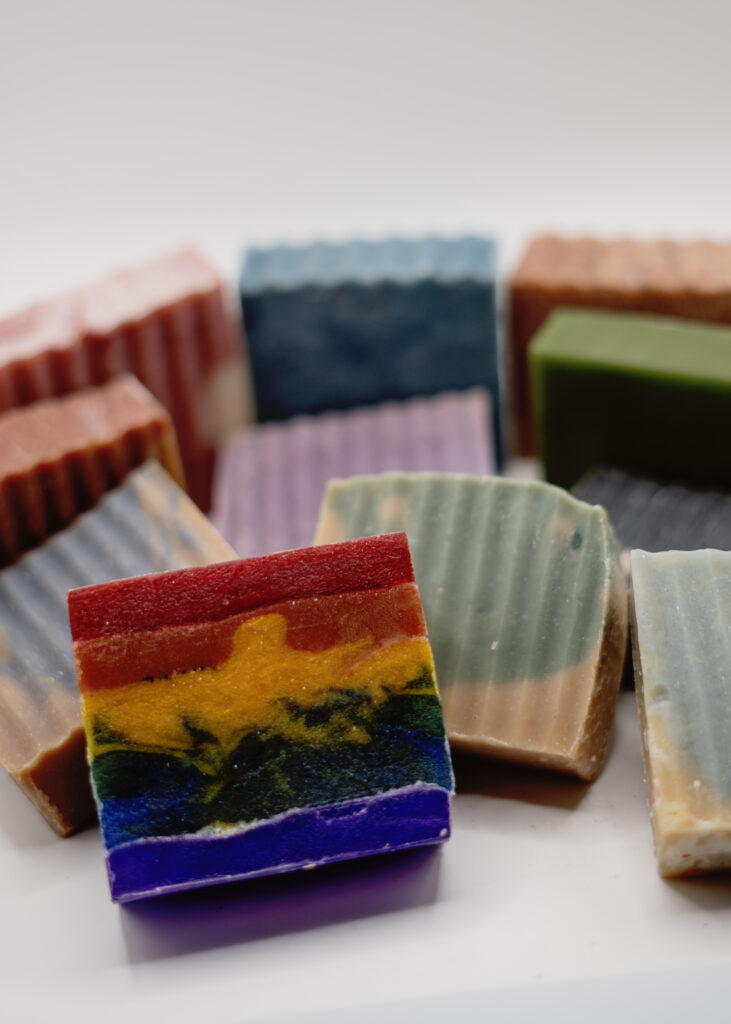
To learn more about how our soaps are designed to uplift and lift up, read about our first month of person to person sales and the impact of those soap sales!